
Russell's Reserve Single Rickhouse Camp Nelson E Review: A Taste of Kentucky Bourbon History

Updated: Dec 20, 2025

“We tend to think of landscapes as affecting us most strongly when we are in them or on them, when they offer us the primary sensations of touch and sight. But there are also the landscapes we bear with us in absentia, those places that live on in memory long after they have withdrawn in actuality, and such places—retreated to most often when we are most remote from them—are among the most important landscapes we possess.”
- Robert Macfarlane, The Old Ways: A Journey on Foot
The latest release of Russell's Reserve Single Rickhouse is finally here, and with it, we have the incredible opportunity to taste a cross section of Wild Turkey's unique Kentucky terroir. With this release examining the Camp Nelson warehouse E specifically, you might be wondering what's so special about Camp Nelson to deserve an expensive release focusing on just this property?
Here's the full scoop.
In order to orient yourself to the sprawling landscape of modern bourbon, I'll give you a few waypoints to set your bearings straight. You'll find the Camp Nelson property nestled above a bend in the big Kentucky River in Jessamine County. This is quite a distance away from the Wild Turkey distillery grounds in Nelson County, which houses their Tyrone warehouses. With the McBrayer warehouses being across the street from the Four Roses Distillery in Lawrenceburg, why would Wild Turkey space out their aging facilities so much? The simplest answer is that it allowed for expansion of aging capabilities without clogging up their original distillery grounds. The more nuanced explanation is that after several years of aging here, a distinctly different character started to show up in their whiskey. This distinct differentiation has given longtime fans of Wild Turkey heart palpitations attempting to nerd out on just why the Camp Nelson character is so much more fruit-forward than Tyrone or McBrayer aged whiskey. The real answer just might be rooted in several hundred years of whiskey history that came before along the banks of the Kentucky River.
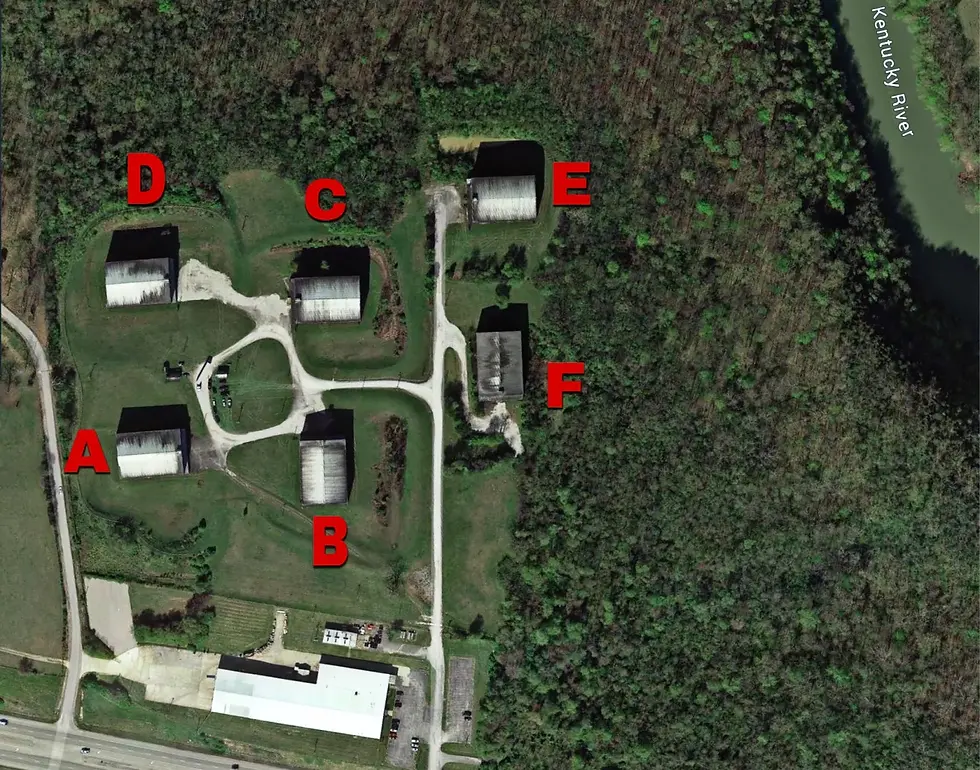
If you're looking for a closer pin on Camp Nelson, you can find the property sitting proximal to the historic Civil War supply depot, as well as the modern Camp Nelson National Cemetery. The site is also on the same historic grounds where the E.J. Curley Distillery was located, the man that produced the first "Blue Grass" bourbons and the legendary Boone's Knoll whiskey from the late 1800s into the early 1900s. Boone's Knoll was the rounded hill above the river near Camp Nelson where Curley set up a distillery that would later be known as the Kentucky River Distillery after Prohibition. These stone and timber buildings were clustered all along the river and up into the hillsides, a full complex of facilities that would have included warehouses, cisterns, stillhouses, and multiple rickhouses. With business booming for Kentucky River Distilling, buildings were erected strategically right up into the post-war era. The wood and metal rickhouses that Wild Turkey would later call the Camp Nelson warehouses (A through F) date specifically to this post-war era, right around 1946.
In the 1960s, the Kentucky River Distillery was sold to Norton Simon, the parent company of Canada Dry. It was at this time that the plant was switched over to attempting to produce a Canada Dry Bourbon in an attempt to carry over Canada Dry's reputation as a good whiskey mixer into the whiskey industry itself. This whiskey was stored in the Camp Nelson warehouses for a number of years before keen tasters started to catch on to some obvious quality flaws, earning the reputation as the "worst whiskey in Kentucky." It was harsh whiskey that even employees described as "musty," an attribute they perhaps foolishly blamed on the Camp Nelson warehouses themselves.
In 1972, disaster struck for the Kentucky River Distillery when a fire burned the stillhouse at Camp Nelson, putting the distillery completely out of commission. The rickhouses survived, however; otherwise, we wouldn't be sipping on this Single Rickhouse bourbon today. With the Canada Dry Bourbon dream dead on arrival and with distillery operations defunct at Camp Nelson, the site became a simple aging complex, which is the role it still serves today. In the later years following the fire, the Camp Nelson warehouses were leased to Seagrams, where they likely aged Four Roses and other Seagrams brands as an overflow storage location for production from other Kentucky plants. When Seagrams was dismantled around 2000, its whiskey assets began to split, with a majority of them going to Pernod Ricard, which was the parent company of Wild Turkey at the time. The Camp Nelson warehouses would start phasing out Four Roses barrels at this time, which was when Wild Turkey whiskey made its first entrance to this storyline.
The year 2009 saw Campari buying the Wild Turkey brand and its associated assets, including the rights to use the Camp Nelson maturation campus. New minds bring new ideas, but for years Camp Nelson was just a string of characters on barrel spreadsheets as Wild Turkey continued to age massive volumes of whiskey across their three campuses. The ushering in of the single barrel era changed everything. Long time whiskey enthusiasts like David Jennings of Rare Bird 101 started to take notice of the details listed on hang tags of Kentucky Spirit and Russell's Reserve single barrels. "CN-C", "CN-E", and "CN-F" began to develop a cult-like following from some of the most devout tasters.
By 2022, Wild Turkey was ready to let the cat out of the bag and acknowledge Camp Nelson's unique aging environment. The Single Rickhouse release was launched to shed light on this particular cross section of Wild Turkey's not-so-diverse portfolio. Producing just one bourbon and one rye mash bill, this is a distillery that has long focused on consistency rather than experimentation. With little distillation differentiation, leaning in on maturation differences and terroir was only natural for the brand. The inaugural release is perhaps the most important, as warehouse C was subsequently demolished after this bottling, ending the historic run after seeing continuous use since 1946.
Russell's Reserve Single Rickhouse release history:
2022: Camp Nelson C – Barrels from floors 3 and 4
2023: Camp Nelson F – Barrels pulled from floors 4 and 5
2024: Camp Nelson B – Barrels pulled from floor 6
2025: Camp Nelson E – Barrels pulled from floor 5

With such a rich and storied provenance of the property, it's no wonder that long time whiskey enthusiasts have a bit of an obsession with Camp Nelson. Having tasted some exquisite Boone's Knoll whiskey from the early 1900s, as well as countless examples of Camp Nelson E single barrels, I'm left with a deep appreciation for what this region of Kentucky has contributed to the history of American whiskey. It's easy to see far when standing on the shoulders of giants, however, and I'm quite curious to see what the team at Wild Turkey has come up with for this unique blend of CN-E bourbon. If that hype wasn't set up enough, I'll leave you with one more fact: this is the highest proof official bottling under Russell's Reserve label, ringing in at a bold 128 proof, or 64% alcohol by volume. Now let's dive in for a full review!
Company on Label: Distilled & bottled by the Wild Turkey Distilling Company, Lawrenceburg, Kentucky
Whiskey Type: Kentucky straight bourbon whiskey
Mash Bill Percentages: 75% corn, 13% rye, 12% malted barley
Proof: 128°
Age: Non age stated (assumed to be 10-15 years)
MSRP: $300 (2025)
Availability: At the distillery, online, and at select retailers on a limited basis
Further identification: The 2025 Camp Nelson E is the fourth Single Rickhouse bottling that released in October of this year
Nose: Woah, that rich rickhouse funk is on full display right off the bat with this glass! There are oodles of toffee, black pepper, and white chocolate with the volume knob cranked to the max from the aroma department. Nosing further, I find raspberry jam, red currant, and a solid backbone of graham cracker. I can already tell this is going to be a doozy when it hits my lips, but I find that I can plunge my nose to any depth I like without finding any heat in the nostrils—an incredible feat for any 128 proof whiskey. Long inhales are creamy as can be, leading with buttermilk frosting before sending forth a crescendo of light white pepper. After a sip is when this glass gets really interesting; gunpowder and chimney smoke have me wide-eyed, both excited and nostalgic at the wonder of this pour. Searching deeply produces a subtle wintergreen mint sprig completely engulfed in delectable dark chocolate. As the oak tones begin to weigh in a bit heavier around the 45-minute mark of this pour, I find myself still at one with it—not rushing, just thoroughly enjoying, accepting when a specific note doesn't come to mind. My inner Zen teacher is both blushing and bruising at this paradox of me writing it out. Golly, this is a great-smelling whiskey. Light citrus tones add the perfect level of underlying complexity to truly make this an enigmatic bourbon. As the glass wanes after a full hour in the glencairn and the liquid level diminishes from my fervent exploratory microsips, what is left in the glass is still beautiful. I find myself in a sparse greenhouse, with a few work-in-progress projects up on plywood shelves and many empty pots piled up waiting for a cause. When I close my eyes and inhale, I see mostly white, though sunlight casts green tones throughout the glass too. Aromas of vanilla bean come on strong as I begin to accept that this is the end of the road for this glass, grateful to it for having told me several incredible stories along the way. The ruefully empty glencairn smells of orange marmalade, cranberry sauce, and slivered almonds.
Palate: My first taste is accidentally a rather large one, and my mouth surely notices that its first sip of the day is a beastly 128 proof that carries with it cherry cordial, amaretto, grenadine, and a splash of sweet vermouth. Right away I notice that this is a sticky, thick, viscous whiskey that has all the hallmarks of housing quite a bit of double-digit aged whiskey within. Molasses, cedar, and a touch of coconut surprise this old American whiskey enthusiast after the long linger finally passes. Another sip confirms my initial thoughts: this is a monster whiskey. Acts of tasting bravery are rewarded with new facets to discover as my tongue turns over stewed apricot, plum pudding, and a tingle of orange zest. As I sit with this glass, I find myself right around Christmas time, spending most of my mornings and evenings sitting in the woods glassing for deer before coming home to something absolutely delicious that my dad pondered up and then perfected. With my present self now fully back with this glass, I continue to add enjoyment to my day as each small sip somehow improves over the last. This one offers a pinwheel of waffle cone, angel food cake, and buttermilk frosting. It's certainly still quite boozy, not the kind of pour I would likely share with novice whiskey drinkers, but completely manageable given the mouthfeel and flavor spectrum that I have divulged. My favorite part of this glass is the consistent evolution through a cohesive complexity. While the macroevolution of the glass is this slow, undulating constant, the vibrant tones surrounding it, leaping off its surface, and dancing on the tongue like nobody is watching are what really get me. This is the kind of whiskey I love. My mind fights the urge to finish this glass because I know part of me will be disappointed for its passing. The other part of me knows I will be a better taster tomorrow for having had it and then calling it a day. My last sip is just as bodacious as I expected it to be. Cherry cordial comes full circle in that fruity character I have found on so many of my favorite Camp Nelson E barrel picks of Russell's Reserve through the years. The finish is long, smoldering, and effervescent with Fig Newton bold and sweet, while orange zest trails off shimmering like the sun on a ripple in a river.
TL;DR: This is what it is all about right here. This is Kentucky bourbon done right.
Rating: 4.5/5

What an incredible opportunity to taste the Camp Nelson warehouse E bourbon in all its cask strength glory. Certainly geared toward the tenured whiskey enthusiast, this is easily one of my favorite whiskeys I have tasted in 2025 and is also likely my favorite Single Rickhouse bottling to date. Put this alongside Wild Turkey Master's Keep Beacon, and you have a distillery that is firing on all cylinders. Let me know down in the comments if you'll be hunting for this one!


Great review! Really enjoying this release, and agreed it’s comparable with the Beacon!